
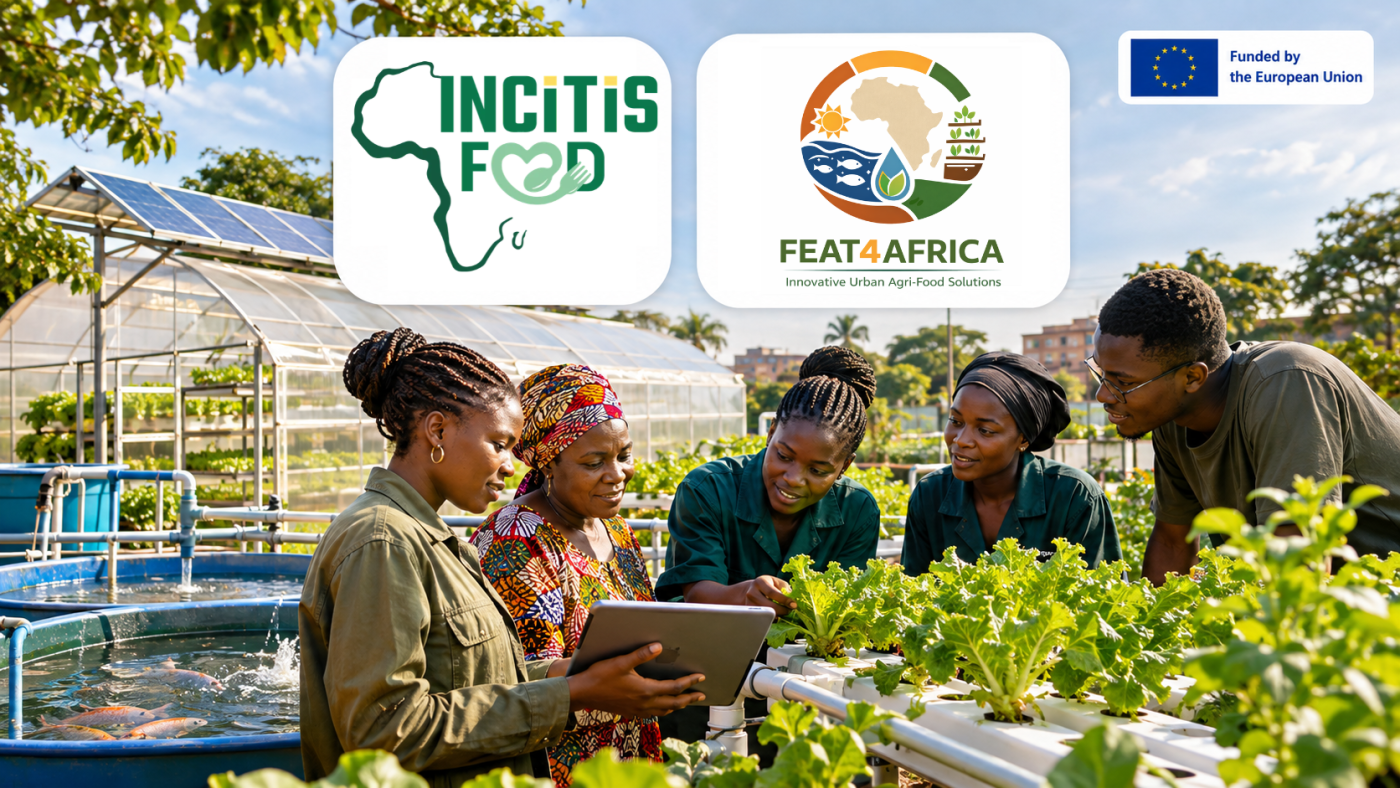
Sustainable urban food systems require more than innovative technologies. They depend on solutions that respond to local needs, involve communities in their development, and create opportunities for people to participate in more resilient and inclusive food value chains. Recognising this shared vision, the INCiTiS-FOOD and FEAT4AFRICA projects have formalised their intention to collaborate through a Letter of Intent signed in June 2026.
The collaboration brings together two EU-funded initiatives working to strengthen food and nutrition security in African urban areas through innovative agri-food technologies, Living Labs, and stakeholder-driven approaches.
Shared Goals, Complementary Approaches
Both projects address the challenges of urban food systems by promoting sustainable food production, circular practices, and the active involvement of local stakeholders. They also share a commitment to empowering vulnerable groups, particularly women and young people, and to developing solutions that can contribute to more inclusive and resilient communities.
FEAT4AFRICA aims to improve food and nutrition security in African cities by introducing accessible, low-cost, soilless and solar-powered food production technologies. Its approach includes hydroponics, bioponics, aquaponics, and recirculating aquaculture systems (RAS), with the aim of strengthening the Food-Water-Energy-Health Nexus and supporting sustainable livelihoods.
Through its network of Living Labs, the project brings together research institutions, civil society organisations, local authorities, and other stakeholders to co-create urban farming approaches and circular agri-food practices. Its activities span five African regions, with Living Labs and case studies involving Ethiopia, Nigeria, Cameroon, Namibia, and South Africa.
INCiTiS-FOOD, meanwhile, focuses on integrating innovative and circular technologies into urban agri-food systems in African cities. Through its Living Labs, the project explores practical solutions such as hydroponics, aquaponics, and insect farming, while fostering collaboration between researchers, entrepreneurs, local communities, and other food system actors.
Connecting Innovation with Local Needs
The projects’ approaches are closely aligned in their emphasis on practical innovation and stakeholder participation. Both recognise that technologies can have a lasting impact only when they are adapted to local contexts, accessible to communities, and supported by knowledge exchange and collaboration.
Their complementary expertise also creates opportunities to share experiences from Living Lab implementation, exchange technological solutions and good practices, and explore how circular approaches can contribute to improved food and nutrition security in African cities.
By connecting research, technology development, and community engagement, the collaboration reflects a common ambition: to make sustainable urban food production more accessible while supporting the livelihoods and agency of local communities.
Looking Ahead
The Letter of Intent provides a framework for exploring joint dissemination and communication activities, knowledge-sharing events, stakeholder engagement initiatives, policy dialogue, and future research opportunities. By building on their complementary objectives and experience, INCiTiS-FOOD and FEAT4AFRICA aim to strengthen the exchange of knowledge and good practices and contribute to the development and wider uptake of sustainable urban agri-food solutions across African cities and regions.
Add a Comment