
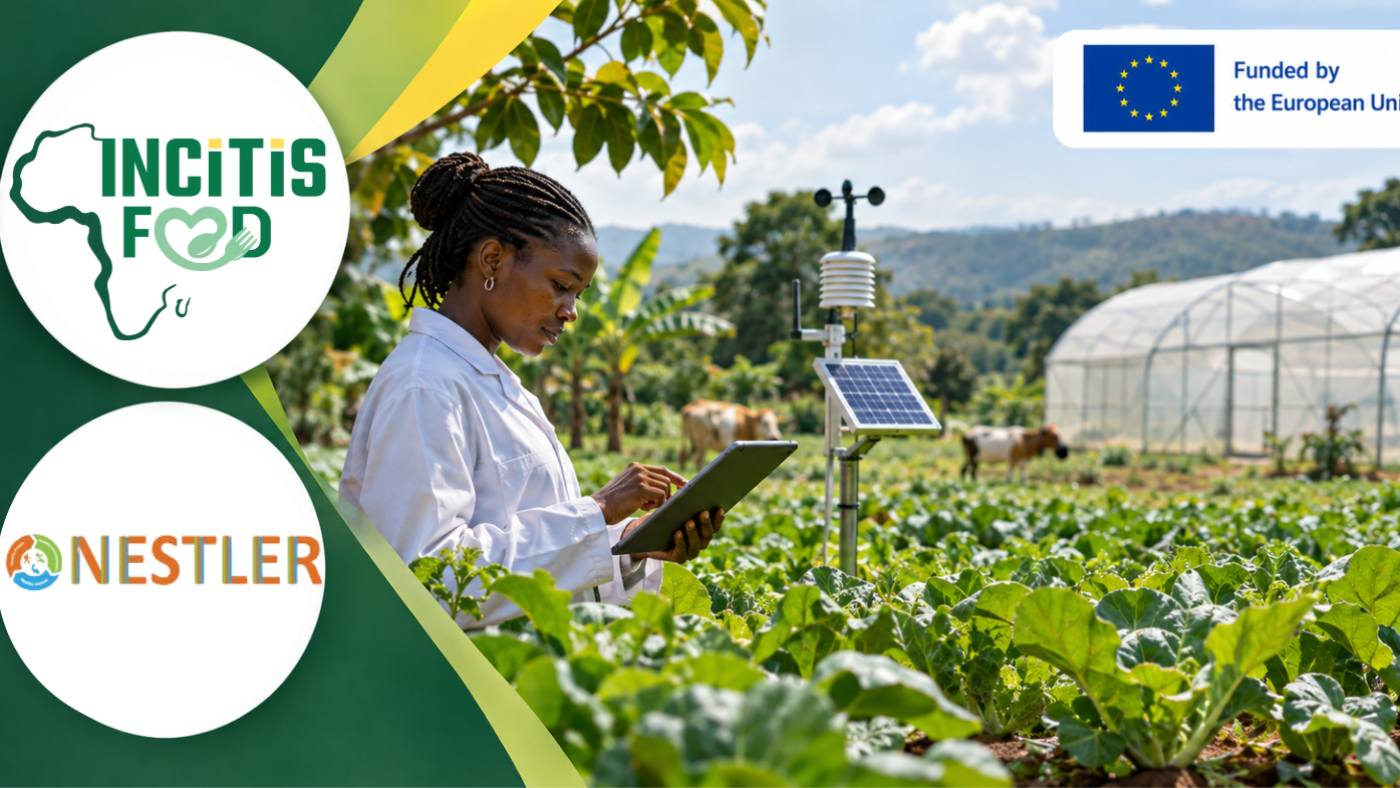
Building sustainable food systems requires more than increasing agricultural productivity. It also means addressing the interconnected health of people, animals, plants and the environment, while making better use of available resources. This calls for integrated approaches that bring together technological innovation, sustainable agricultural practices and cross-sectoral cooperation.
Recognising these shared priorities, INCiTiS-FOOD and NESTLER formalised their cooperation through a Partnership Agreement in November 2025, establishing a framework for knowledge exchange and joint communication and dissemination activities.
A Shared Commitment to Sustainable Food Systems
NESTLER (oNe hEalth SusTainabiLity partnership between EU-AFRICA for food sEcuRity) promotes a One Health approach by bringing together technological and scientific expertise to monitor the well-being of humans, animals and plants. The project develops an integrated digital platform that combines data from satellite sources, unmanned aerial vehicles and Internet of Things (IoT) devices. By applying artificial intelligence, machine learning and remote sensing technologies, NESTLER aims to support data-driven monitoring, risk assessment and more informed decision-making in agriculture and food systems.
The project also explores circular economy approaches, including the use of insect protein in animal feed and the potential of animal waste and insect farming by-products in crop production. Its activities span six African countries, strengthening cooperation between European and African partners in addressing shared sustainability and food security challenges.
INCiTiS-FOOD focuses on improving food and nutrition security and food safety in African cities and towns through inclusive and circular agri-food systems. Working with local stakeholders through Living Labs, the project supports the development and testing of innovative technologies and business models, including hydroponics, aquaponics and insect farming. Its approach places particular emphasis on locally adapted solutions, resource efficiency and opportunities for sustainable food production in urban and peri-urban environments.
Although the projects approach food systems from different perspectives, both recognise that long-term sustainability depends on understanding the connections between agricultural production, environmental conditions, resource management and human well-being.
Where One Health Meets Circular Food Innovation
One of the most relevant areas of convergence between NESTLER and INCiTiS-FOOD is their work on insect farming and circular resource use. Both projects explore how insects can contribute to more sustainable food and agricultural systems, particularly through their potential as an alternative protein source for animal feed and their role in converting organic resources into valuable outputs.
These approaches demonstrate how solutions developed within the agri-food sector can address several challenges simultaneously: reducing waste, improving resource efficiency, supporting alternative sources of protein and strengthening the sustainability of food production. Their successful implementation, however, also depends on considering wider aspects of the food system, including environmental conditions, animal health, food safety and economic viability.
The projects’ complementary expertise provides a valuable basis for connecting these perspectives. NESTLER’s work on digital monitoring, data integration and the One Health approach can contribute to a broader understanding of the factors influencing agricultural and environmental sustainability. In turn, INCiTiS-FOOD’s experience with Living Labs and locally adapted circular technologies highlights the importance of engaging communities and testing solutions in real-life settings.
Together, these approaches reflect the need for integrated, evidence-based and context-sensitive solutions to strengthen food system resilience.
Looking Ahead
The Partnership Agreement established a framework for both projects to strengthen their visibility and exchange knowledge through coordinated communication and dissemination activities. It envisaged mutual promotion of project results and updates, the joint development of communication materials, and the organisation of a thematic webinar, subject to the availability of both partners. The agreement provided a basis for sharing relevant experiences and good practices, while connecting stakeholders interested in One Health, digital innovation and sustainable food systems.
Add a Comment